
Here's Your Economy on Tariffs
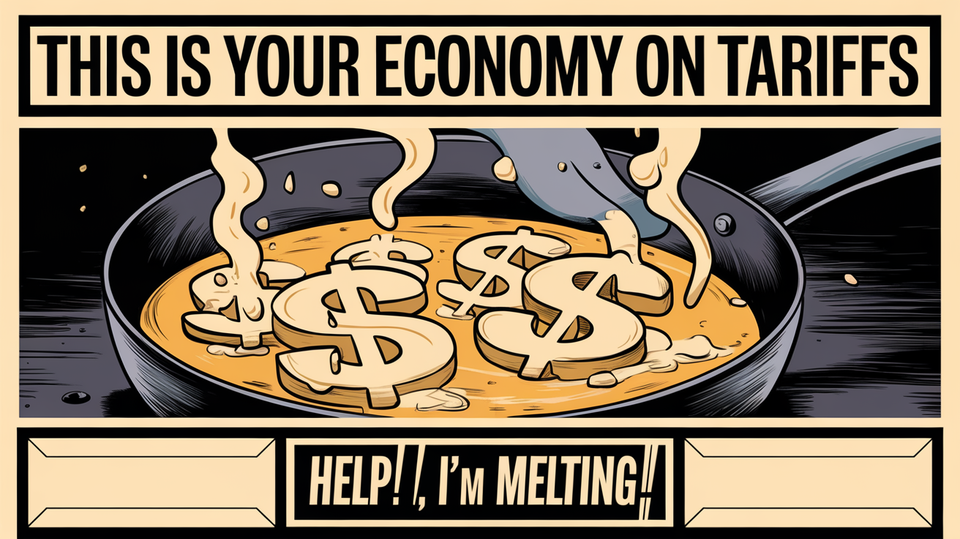
Let’s get straight to it.
What is a tariff?
Tariffs are taxes. They’re imposed by a government on imported goods or services. The primary purpose of a tariff is to increase the cost of imported items, making them less competitive compared to similar domestic products.
Imported goods + tariff = higher price | Domestic goods + zero tariff = lower price
But they are used for multiple purposes, including protecting domestic industries from foreign competition, generating government revenue, and influencing trade balances.
The primary goal of a tariff is to make imported goods more expensive. In theory, this should encourage consumers to buy more domestic products, generate additional revenue for the government - tariffs in the US are collected by the U.S. Customs and Border Protection (CBP), a part of the Department of Homeland Security - and shift trade imbalances.
Tariff revenues are usually deposited in the governments general fund and used as a part of the overall budget funding multiple government agencies.
Overall, tariff revenue is less than 2% of total federal revenue.
The Pros and Cons of Tariffs
Doesn’t sound so bad. There would seem to be a lot of positives that come with tariffs.
But let’s take a closer look:
Pros:
- protection of domestic industries - tariffs are usually aimed at specific industries and not rolled out across all imports. Our economy does not work in a vacuum. Increased costs in one area usually result in higher costa across a whole spectrum of industries.
- job preservation and creation - more demand for domestic goods should increase domestic manufacturing and create more job openings.
- government revenue - creates revenue our government can use to fund it’s projects.
- negotiating leverage especially with trade - countries on the receiving end of tariffs don’t like tariffs. These can be used to negotiate trade pacts, create strategic alliances, and even be used in settling national security concerns
Cons:
- higher consumer prices - historically, this has been inevitable. Tariffs increase the cost of consumer goods. Manufacturers pass on this additional cost in their pricing. If you’ve been paying $100 for a HDTV from China and China gets hit for a 10% tariff on all TV’s, you’ll now be paying $110 for the same HDTV. And in practice, the costs will usually be greater since the costs of raw materials will likely go up as well. Manufacturer’s do not pay for tariffs. Countries, such as China, do not pay for the tariffs. This is a tax on you. Consumers pay the cost of tariffs.
- Retaliation and trade wars - if you punch me, I’m likely to punch back. Same for tariffs. If the US places a tariff on China goods, China will place tariffs on US imported goods. This creates an expansion of goods that have tariffs on either side which can lead to a more closed market.
- Inefficiency - tariffs reduce competition. Domestic markets no longer have to compete with international products. Therefore, they are not driven to innovate and to improve their efficiencies. R&D can become stagnant. Consumers will have fewer choices and less options. Often, these higher production costs and lack of international competition will cause domestic manufacturers to raise their price.
- Inflation - tariffs cause inflation. It starts with pricing. Higher prices increase the consumer price index. When tariffs escalate they tend to increase prices on raw materials which increases the price on finished goods which increase the tariff (since tariffs are usually calculated as a percentage of the total value of the goods). Your dollar becomes devalued since it will now buy less. Interest rates go up.
Some historical tariff examples
Let’s see what we can learn from the past:
The Smoot-Hawley Tariff Act of 1930 - This bill was signed into effect on June 17, 1930 by Herbert Hoover. It was intended to protect American farmers and industries that were being pounded by the impact of The Great Depression. The bill increased tariffs on more than 20,000 products to over 60%.
Gotta give it to them. If you’re gonna be a bear be a Grizzly bear. This increase was unprecedented.
The bill led to a sharp increase in pricing - which the US couldn’t afford - and a mass of retaliatory tariffs from most countries. This lead to a period of protectionist trade policies domestically and internationally and higher pricing with less competition. It also hurt American farmers and manufacturing exports.
The common belief is that this act deepened and lengthened the depression, increased pricing, and handicapped American manufacturing.
It did lead to the Reciprocal Trade Agreements Act (1934) signed by Franklin Roosevelt. This act granted the executive branch the power to negotiate trade agreements and to reduce tariffs. The goal was to increase cooperation internationally, reduce tariffs, and foster trade cooperation between countries. Eventually, this led to the General Agreement on Tariffs and Trade (GATT) (1947), which was a multilateral agreement to further reduce tariffs and increase international trade and economic recovery. Eventually, the GATT reduced all of the tariffs implemented under Smoot-Hawley and became the WTO.
Result: higher prices, prolonged depression, reduced international cooperation, and loss of American manufacturing and farming jobs.
The Chicken War - in the 1950’s and early ‘60’s,, the US knew how to raise chickens. Advanced animal husbandry techniques, farming efficiencies, cost of feed, and modern production facilities made our chickens the cheapest in the world. Europe and especially West Germany, imported tons of US chickens. The US was on track to sell about $50 million - about half a billion in today’s dollars - worth of chickens. This was damaging the entire European farming industry.
West Germany placed a 25% tariff on US chickens. The price for a 5 lb. chicken from the US increased from $1.60 to $2.25. And it worked. Sort of. Europe stopped importing American chickens, and Germans paid a higher price for their food, and had fewer choices, and some early food shortages. But German farmers were happy.
Then the US retaliated.
In 1964, under President Lyndon B. Johnson, the United States imposed a 25% tariff on several imported goods from Europe, including light trucks, brandy, dextrin, and potato starch. Over the years many of these tariffs were reduced or eliminated. But not for light trucks. Light trucks from Europe still have a 25% tariff. It’s one reason you don’t see any European trucks on our roads today.
Result: The tariff on trucks reduced the competition faced by American manufacturing. Prices remained high but the big impact may have been on innovation. Smaller trucks with more efficient fuel capacity were slow to be developed. It also opened the door for light trucks from Asia.
Trump's 2018 Tariffs on China - U.S. companies importing goods from China faced increased costs due to tariffs ranging from 10% to 25% on approximately $550 billion worth of Chinese products. This slate of tariffs was intended to send a political message to China, return manufacturing to the US, and reduce our trade deficit. These additional costs were passed on to consumers. It cost the average American household about $1,700/year for a total of around $1.5 billion. This was in effect a $1.5 billion tax increase paid for by American households.
The tariffs did increase jobs. Washing machine manufacturing created about 1,800 new jobs - mostly European companies in the US. In total, manufacturing jobs increased about 1.8%. However, due to supply chain increases and higher prices these jobs cost about $815,000 per job. This is not an effective job creation program.
Results: higher prices, disrupted supply chains, increased inflation, and lower than expected job creation at a higher than expected cost.
The law of unintended consequences
In the short term, we know what tariffs will do. They will increase prices. They will slow growth and innovation. And they will not effectively create jobs. This has been proven time and time again.
However, we can’t say for sure what will happen in 5 years, or 10, or 20.
Here are some results of previous tariffs that were unexpected and could happen again:
- There will be retaliatory tariffs making it more difficult to export US goods. But also we may see tougher inspections, delayed business licenses and permits, and slow customs clearances. These operations can add significant costs to US goods.
- Currency devaluation - In response to Trump’s tariffs, China allowed their currency to weaken. This helped Chinese imports stay relatively competitive despite the tariffs.
- New sources - China’s tariff’s on the US in response to Trump were focused on the agriculture industry. The soy bean market was especially hard hit. Tariffs reduced soy bean shipments to China by 90%. The tariffs effectively wiped out this market. China was forced to find alternative suppliers and the US has never regained a significant portion of this market. Billions of dollars vanished. Trump created a farm subsidy program to help support the farmers but most of the funds from this program was sucked up by big Agro business. Smaller farms and manufacturers lost out.
- New manufacturing base - China and manufacturing companies began to look for alternative places to manufacture that had not been hit by US tariffs. As such, Vietnam, Malaysia, and Mexico grew their manufacturing bases and benefited from US tariffs. Many Chinese companies have re-located to Mexico. They have not re-located to the US. In fact, Mexico just became the largest exporters of goods into the US passing China.
- Heightened tensions - a lack of cooperation on matters of trade are spilling over to a lack of cooperation in the political field. The world is facing many areas of conflict and world-wide problems that must be faced together. Tariff heighten tensions.
- Corruption - Tariffs can be applied selectively. This gives lots of power to individual trade organization that put tariffs into place. They can be and have been used as political favors. The more nationalistic and closed a marketplace is, the more closed it is to competition and open to corruption and payoffs.
Buckle Up
Tariffs are neither good or bad. On their own, tariffs can be used as a part of a long term plan to impact world-wide and domestic trade and commerce. But only if they are part of a far-reaching economic plan. In the short term, they will cause increased prices, higher inflation, hinder innovation, and reduce choice.
I haven’t seen a comprehensive plan. Just lots of threats of wide sweeping tariffs, possibly up to 60% on all China goods, and 25% on all other imported goods.
This will impact the world’s economy.
We have no idea of how it will re-shape the political and economy landscape. We have no idea of the unintended consequences this policy would create.
Buckle up.
Usually, I roll out a couple of fun things for the weekend in this newsletter. I’ve decided to separate the fun stuff with the article stuff. But don’t worry, fun articles are on the way. And I’ll begin sending out a Friday, have-a fun-weekend edition tomorrow. It’ll be short. Ciao.
If you want to check out some great reading list and see which books have influenced, surprised, educated, and entertained me, check out my book shop here. The lists grow monthly and I don’t recommend any books I haven’t personally read. Or use my book recommendation engine and specific author chatbots. Check it out. It’s fun.
Brain-Slap is a reader-supported publication. To receive new posts and support my work, consider becoming a free or paid subscriber.